26.12.2021

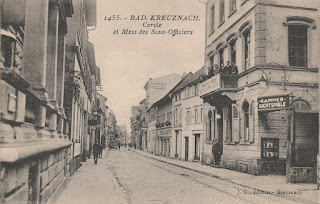
Kammerlichtspiele in Bad Kreuznach / Germany


Bad Kreuznach Kammerlichtspiele cinema cercle et mess des Sous-officiers

A postcard full of history.

This cinema in Bad Kreuznach opened on 16th November 1907 by Gottfried Heym. 

The first presentations were in an extension of the restaurant "Zum Freischütz". Today there is a multiplex cinema with 9 halls and 1400 seats. For more than 100 years, the family Heym-Sawatzki has entertained not only the residents of Bad Kreuznach with movies. Now in the fifth generation.

The cinema wears the name Kammer-Lichtspiele between 1920 and 1970.

After World War I, Bad Kreuznach and the Rhineland was occupated by the French military from 1918 to 1930. Many buildings such as gyms, halls, houses and apartments were confiscated as quarters for the soldiers and civilian employees. (There is a research project being carried out by the University of Mainz about this time.)

Among the occupied building there was also this cinema. It was now "Cercle et Mess des Sous-Officiers" - a non-commissioned officer circle and mess. And a cinema, too. Look at the posters at the entrance.

The postcard was maybe sent. There is written "F.M." instead a stamp. That means "Franchise Militaire". During the entire period of French occupation, normal mail sent by members of the army to France or the colonies in North Africa, where many occupation soldiers came from, was free of charge. The unit's vaguemestre also stamped the postage on the mail items delivered to him, thus confirming the sender's right to postage exemption. And this stamp is missed on the postcard. So the postcard can't dated- unfortunately.
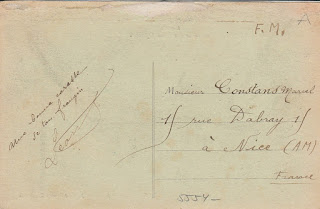


This postcard is a souvenir from Léon to his brother Marcel Constans in Nice. Is Léon in the photo himself? It would be too nice to know who the five men, two women and the child on the balcony are. Is the man in the door the owner of the building? Could the German inhabitants visit cinemas during this years? What kind of movies were shown for the French people?


25.12.2021

Ata-Tau in Almaty / Kazakhstan


cinema Ala-Tau in Almaty postcard 1965

The cinema Alatau was opened in 1960. This postcard is from 1965.

The building was a typical Soviet cinema building. Its architects were Evgeny Dyatlov and Igor Popov. The auditorium originally accommodated 780 people. Alatau has also become a kind of cinema center. Here meetings were held with prominent persons from cinema and theater. Together with the Bureau of Propaganda of Soviet Cinema, the Young Friend of Cinema club was organized, as well as clubs for patriotic, legal and atheistic education. 

In July 2002 the cinema was reopened after restoration with 592 seats. The cinema was closed in 2013 and was destroyed in October 2015.

Today you can find a McDonald's restaurant on this place.

Here you can more read about the History of cinemas in Almaty

28.11.2021

Kinokalender Dresden 2022 / Germany

Kinokalender Dresden 2022 postcard
It is an add card for a special calendar for 2022. It shows 12 views of all Dresden cinemas in A2 format. The photos were made by Jürgen Lösel and Kinokalender Dresden made the calendar. Kinokalender Dresden has published Dresden's monthly cinema program in a newspaper since 1993 and of course online as well. A very good opportunity to find out more about films and where there are shown in Dresden - and without advertising.

On the cover sheet, you can see cinema Thalia in Dresden-Neustadt. I have already a postcard with this cinema and blogged about it.

Now we have another Corona winter. Cinemas here in Saxony are closed. The cinema Schauburg is now a corona test center. I go there regularly. Hard times for cinemas, and not only for them. It is like living in a dystopian film - I still hope there will be a happy end!

About half of the sales proceeds of this calendar go to the cinemas. Of course, that won't save any cinema from closing. But it's a piece of solidarity and a sign of hope for your home for the next 12 months.

"Support your favourite cinema!" 

I am glad, very glad that my idea could be realized. Danke, Andrej!


23.10.2021

Café Cinema du centre in Taourirt / Morocco


Taourirt Rue du Maréchal Joffre Café Cinema postcard
Taourirt is located on the eastern outskirts of Ouarzazate. Its biggest attractions: The Kasbah and the Cinema Museum. The Kasbah is one of the largest Kasbahs in Morocco, built by Pasha Glaoui in 19th century. The Cinema Museum is located opposite Taourirt Kasbah and has collected memories of the films that were shot here.
Did you know, the Ouarzazate area is a noted film-making location, with Morocco's biggest studios inviting many international companies to work here. Among them films like Lawrence of Arabia (1962), The Man Who Would Be King (1975), The Living Daylights (1987), The Last Temptation of Christ (1988), The Mummy (1999), Gladiator (2000), Kingdom of Heaven (2005), Kundun (1997), Legionnaire (1998), Babel (2006) Hanna (2011), The Hills Have Eyes (2006), and Salmon Fishing in the Yemen (2011)
It was also the location of an episode of the television series The Amazing Race 10, Game of Thrones (Season 3), Prison Break (Season 5).

But I couldn't know anything about this Café Cinema du Centre on the right. The postcard is maybe from the 1920s.


Der neue Primus-Palast in Eschweiler / Germany

Der neue Primus-Palast Eschweiler postcard 1958

Der neue Primus-Palast (The new Primus-Palace) in Eschweiler near Aachen is not the first cinema called Primus in Eschweiler. 
The first Primus-Palast opened on 4 September 1928 in Englerthstrasse. It had 1200 seats, and burned out in 1944.
An interim cinema was makeshiftly prepared in June 1947 in the Schützenhalle as Primus in der Schützenhalle
In 1953, a newly built Primus-Palast opened in Grabestrasse with the color film Maske in Blau / Mask in Blue (West Germany, 1953). A dignified place to stay. Tasteful fabric coverings, fine wood paneling and a strong, profiled stucco ceiling with indirect lighting give the auditorium a festive note. Particularly attractive: the large stage with a parade curtain illuminated from above. This is the cinema on the 1958 sent postcard. 
Just 10 years later, on 12 October 1963, the cinema closed and a supermarket was housed in the building. There is still a supermarket on this address, and probably still in the old cinema building.
Later the Primus-Palast moved with its name to the building of the Capitol- a 1957 opened cinema with 682 seats, later departed intwo halls. It existed as the last cinema in Eschweiler until autumn 2020. Look here a last sad shot from the Primus Palast Eschweiler.
At all - there were four cinemas called Primus in Eschweiler from 1928 till 2020.

16.10.2021

Cinématophone Modern Theater in Lyon / France


Ken Roe writes on Cinema Treasures: "The Cinematophone Modern Theater was opened by Alexandre Rota in October 1906.  ... It was designed by architect J. Fanon of Lyon. The Cinematophone was an early record player which was used to provide background sound to silent films. It was used in the name of the theatre to promote the fact that the Modern Theater had it installed."

Cinématophone does not seem to have existed in any other French city at the time.

Alexandre Rota was born in Candelo, Lombardy in 1868, he appears as a “patron weaver” in the 1901 census in Lyon. He was as the director of the Bellecour cinema in Lyon in 1905. In October 1906, he opened another cinema hall - the Cinématophone-Modern-Theater. 
He wrote about his activities: "Development of cinematography in all its forms - Purchase, sale, rental of devices, new and second-hand films - Rental of films from 0 fr 01 per meter and per day - Home screenings, fixed price for one or more screenings - Treaties for the end of shows in casinos, music halls, concert halls, boarding schools, lounges and families - Photographs, light projections - Fixed price installation of cinematographic stations - Advertising by the cinematographer - Electricity - SGDG patent for cinematographic projection in broad daylight".
Alexandre Rota, an entertainment entrepreneur, also an engineer, patented for having apparently made it possible to organize open-air cinema sessions in the middle of the day. He had obtained a gold medal at the Congress of Inventors of Lyon in 1911. It is known that Alexandre Rota knew how to handle a camera. He thus manages to show in his cinema a film on the funeral of Cardinal Coullié, shot by him that very morning. [Source]

Philippe Célérier writes more about this cinema on his blog
"The original 400-seat hall (only 230 in 1961) looks a lot like a theater, with its two side galleries. 
The establishment often changed its name: Modern'Cinéma from 1936 to 1953, Duo from 1953 to 1979, Modern '39, then finally Petit Coucou from 1979 to 1985. Its programming will also experience a lot of upheavals: if in 1958, the Duo is the first art house in Lyon, the Petit Coucou will move towards another genre of cinema, even being classified X in 1979 and 1982, before closing its doors definitively in March 1985 ..."

A. Rota was also a good salesman, when he used the popular postcard as advertising. Maybe the man in the little picture is Alexandre Rota himself? Surely he doesn't stand there by chance.


10.10.2021

Neues Filmtheater in Bad Schandau / Germany


Neues Filmtheater Bad Schandau Postcard 1956

The cinema Neues Filmtheater was opened in 1953, later called Filmtheater des Friedens (Movie Theater of Peace).

It was closed as a cinema in 1991 and used briefly as a games library. In October 2001 it was opened as the Saxon Switzerland National Park House. The building was gutted for this. The exterior of the building has been well preserved and adapted to the new task. 

The building is a historical monument.

The old analog projectors also got a second chance. They are now used in the Dresden cinema Museumskino Ernemann VII B. The museum cinema has been part of the Dresden Technical Collections since 2002. These are located in the former Ernemann factories (later Pentacon). Cinema projectors and cameras were manufactured here for almost 100 years until 1991.

Royal Cinema in Gabès / Tunisia


Royal Cinema Gabés Tunisie postcard
Gabès is a city on the Mediterranean coast of Tunisia. It has about 120,000 inhabitants and is the 6th largest Tunisian city.

It is not easy to find facts about cinemas in Gabès. In French Wikipedia there is written about Cinemas in the colonies.

In Gabès there was the  L'Atlantide Cinéma with 600 places, directed by Mr. Sauveur, Raphaël Scozzaro and Emile Saada. It opened in 1937.


15.09.2021

Radio City Cinema in Tehran / Iran


Radio City Cinema in Teheran postcard
Radio City Cinema was opened on 18 September 1958 in Tehran. It was designed by Heydar Ghiai (1922 - 1985), a pioneer of modern architecture in Iran. His buildings include the Moulin Rouge Cinema, the Senate Palace and the Hilton Hotel in Tehran.
The architecture of the entrance facade was designed in googie style. Red neon lights were installed on the outside of the cinema that glowed at night and gave the cinema a modern look.
The cinema had 1,400 seats and the screen had a width of 14.5 meters.

The Radio City opened with a screening of Les bijoutiers du clair de lune / The Night Heaven Fell - a 1958 French-Italian film directed by Roger Vadim with Brigitte Bardot. The cinema became one of the most visited cinemas in Tehran, showing intellectual films, most of them were US-American films.

Cinemas of the same name were built in major cities in Iran:
- the Radio City Cinema in Mashhad, opened in 1959
- the Radio City Cinema in Rasht, opened in 1965

In July 1973 a bomb incident occurred in the cinema. The cinema was burned during the Iranian revolution in November 1978 like the cinemas Capri, Chest Monde and Moulin Rouge. In the 1980s the cinema became a pharmacy for a while.

In February 2018, the cinema building was placed on the national list of monuments.

The postcard was sent in 1963. It shows the cinema advertising the movie The King and I (USA 1956).

Azar Nafisi writes in her book Reading Lolita in Tehran about watching Tarkovsky in Tehran.
There was a retrospective with Tarkovsky's movies in 1988 (he died in 1986) during the Fajr-Film Festival. The films were shown in Russian with no subtitles and censored. Tickets were traded on the black market, everybody wanted to see Tarkovsky. Azar Nafisi had the chance watching Tarkovsky's The Sacrifice and writes about this event:
“Looking back on that time it seems to me that such rapture over Tarkovsky by an audience most of whom would not have known how to spell his name, and who would under normal circumstances have ignored or even disliked his work, arose from our intense sensory deprivation. We were thirsty for some form of beauty, even in an incomprehensible, overintellectual, abstract film with no subtitles and censored out of recognition. There was a sense of wonder at being in a public place for the first time in years without fear or anger, being in a place with a crowd of strangers that was not a demonstration, a protest rally, a breadline or a public execution.”

11.06.2021

Fox Theatre in Detroit / USA


Fox Theatre Detroit postcard
I got this postcard from Ron via Postcrossing.

He wrote he is remembering theaters like this.

Much is reported about the theater on Wikipedia.

Today the historic Fox Theatre in Detroit is the largest surviving movie palace of the 1920s with over 5.000 seats. The theatre was fully restored in 1988. But it isn't used as a cinema anymore. You can visit there different venues and concerts.

Thank you. Richard, for this postcard!