Posts mit dem Label France werden angezeigt. Alle Posts anzeigen

01.03.2025

Cinéma in Taglio-Isolaccio / France


Taglio-Isolaccio is a French commune on the island of Corsica.

There is a "Centre de Vacances, de losirs et de repos" - "Holiday, leisure and rest center" with a cinema hall. Unfortunately, I was not able to find out more about this place.

22.02.2025

Eden in Saint-Jean-d'Angely / France


Theatre and Cinema Eden in Saint-Jean-d'Angely, postcard

An old postcard with a cultural building still in work.

And a good summary of the history on its homepage.

The Eden theatre-cinema was built in 1931 in just 76 days. This work designed by the architect André Guillon (1896-1992) presented at the 1935 Brussels World Fair, earned him a silver medal.  The hall could accommodate 1,100 people. The façade decorated with two bas-reliefs, one on the right "Ars" evoking the art and ballets of Joséphine Baker, the other on the left "Scientia" representing cinematographic science. The large entrance was framed by two high pilasters at the base of which were embedded the posters of the shows. Above the entrance, a large glass roof, in the shape of a butterfly wing, brought light to the interior bar. The entire interior, composed in the art deco spirit, columns of the bar and the entrance hall, capitals dressed in colored glass, was illuminated.

In 1984, the façade and the bar room were included in the supplementary inventory of Historic Monuments.

Since 2004 it has been closed due to dilapidation, the side facades and gables showed obvious cracks. A new small space, L'Éden Pasteur, replaced the old cinema from this time.

In May 2014, a fire destroyed the entire building, only two bas-reliefs were preserved.

Emblematic site for the people of Angers, the municipality wanted to breathe new life into this heritage echoing in the collective memory of the territory by recreating a performance hall, a facility serving a cultural policy facilitating access to culture for as many people as possible in the rural territory of Vals-de-Saintonge.

The New Eden performance hall opened its doors on 7 September 2018 with a modern hall (319 seats) for theater, galas, film screenings and various shows.

17.03.2024

L'Eden-Cinéma in Lons-Le-Saunier


L'Eden-Cinéma Lons-Le-Saunier postcard

The 1913 sent postcard shows "L'Eden-Cinema" on the Promenade de la Chevalerie in Lons-Le-Saunier (Jura). 

Le Progrès writes about this place: Cars are now invading “Promenade de la Chevaliere”. It was once a pleasant place for walks, as its name suggests, with large trees. There was a charming bandstand there, built in 1878 and disappeared less than a century later, in 1974, without us really knowing under what circumstances. The band of the 44th infantry regiment garrisoned in Lons or the Municipal Harmony gave concerts there on Sunday afternoons and Thursday evenings in the summer.

Next door was the Chalet café where the Lédoniens stopped for refreshments. In 1908, it covered and closed his upstairs terrace. Particularly for thermal spa guests, the café sets up a stage and gives shows, taking the name Kursaal. In 1912, he succumbed to the cinema craze and became “Eden-Cinéma”. This was the first cinema in Lons-le-Saunier. Later, it took the name “The Regent”, until 2014 when it fell under the blows of excavators and demolition workers to transform into a modern multi-room: “The Mégarama”.

The Mégarama multiplex with 7 rooms and 990 seats was designed by the Carril architectural firm. 

13.02.2024

Cinematographe in Marseille / France


Marseille Cinematographe Gaumont Quai du Port postcard

"Marseille - Rue de la République" is written on the 1920 sent postcard. But the address of the cinema in the middle of the picture was not "Rue de la République" - it was "2, Quai du Port". 

Under the large letters “Cinematographe” you can read “Bar de la Samarite" - today "La Samaritaine", a brasserie since 1910 at Quai du Port, opposite the old port.

You can see the Gaumont-logo over the large letters.

Salles-cinema.com tells that Gaumont has shown films directly in the "Bar de la Samarite".

"La Samaritaine" was a filming location for 1971 US-American neo-noir action thriller film "The French Connection".

17.12.2023

Kino - Theater in camp Saalburg in Autry / France

cinema Kino-Theater Saalburg Autry postcard 1918

 
"Kino in Saalburg. Fritz Beck als Führer. Mai 1918"

This postcard is more of a photo than a postcard, but was intended (and probably sold) as a postcard. The place, person and time are noteworthy on the back - and this is how the cinema depicted can be identified.

Saalburg is not the little town in Thuringia on the river Saale, and not the Roman fort located on the main ridge of the Taunus, northwest of Bad Homburg in Hesse. 

The German camp Saalburg was established during World War I near the occupied place of Autry, 50 km east of Reims. It is possible that the camp got its name after the Hessian fort of Saalburg. The camp and the place of Autry were destroyed by fighting in October 1918. Today there is forest and peace again. 

Here I found an interesting article about the camp. Unfortunately, the cinema is not mentioned. Perhaps it was built in May 1918, as written on the postcard. I think the building was used as a cinema and theater.

The soldiers with the tools look like they have just finished the building. One of them is marked with a cross. The only one who doesn't look at the camera. Maybe it's the aforementioned Fritz Beck. I'm not sure what kind of "Führer" / leader Fritz Beck was. The head of cinema construction or the Vorführer / projectionist or the artistic director? I am sure that cinema-theater complied with all applicable German regulations. 

Postcards in World War I are a very interesting topic. They show a desired self-expression. They are souvenirs for the army member themselves but also for their relatives and friends at home. When you look at the postcard, you think of a holiday camp for big boys rather than a war place. 

At the same time, it is often not easy to locate postcards with front-line cinemas because they worked under exceptional conditions. There is little information about it - how many places there were, what was shown when, who performed, how was the film distribution. That's why this postcard with the comments is an important contemporary document.

17.04.2022

Ciné-théatre de la Ponatiere in Échirolles / France


 Échirolles is a city near Grenoble, Ponatiere is a district of Échirolles.

The cinema opened in 1941, but it has never been a place exclusively dedicated to film screenings. It is more of a party hall in which spectators came to attend various shows. Screenings were to be more frequent in the 1940s and 1950s, when television was not yet widespread in all homes.

Now there is a big multiplex in Échirolles with 12 screens and the writing on the building has disappeared. It seems to be only a stage now.
13.03.2022

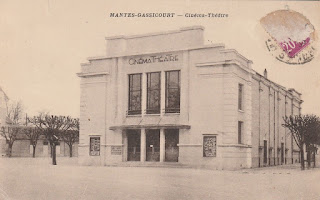
Cinéma-Théâtre in Mantes-Gassicourt / France


Mantes-Gassicourt, since 1953 Mantes-la-Jolie, is 48 km to the northwest of Paris. 

The first Cinéma-Théâtre was opened on 4th November 1921, built on the site of a theater destroyed by fire. First shown film was Les Trois Mousquetaires (France, 1921).

That cinema was closed on 2nd February 1934 and the new Cinéma-Théâtre was built on this site. It was opened on 22nd August 1934 and had about 1.100 seats. It has been demolished too. 

A new 9-screen CGR multiplex has been built on the site in 2000 and still shows movies. 

16.10.2021

Cinématophone Modern Theater in Lyon / France


Ken Roe writes on Cinema Treasures: "The Cinematophone Modern Theater was opened by Alexandre Rota in October 1906.  ... It was designed by architect J. Fanon of Lyon. The Cinematophone was an early record player which was used to provide background sound to silent films. It was used in the name of the theatre to promote the fact that the Modern Theater had it installed."

Cinématophone does not seem to have existed in any other French city at the time.

Alexandre Rota was born in Candelo, Lombardy in 1868, he appears as a “patron weaver” in the 1901 census in Lyon. He was as the director of the Bellecour cinema in Lyon in 1905. In October 1906, he opened another cinema hall - the Cinématophone-Modern-Theater. 
He wrote about his activities: "Development of cinematography in all its forms - Purchase, sale, rental of devices, new and second-hand films - Rental of films from 0 fr 01 per meter and per day - Home screenings, fixed price for one or more screenings - Treaties for the end of shows in casinos, music halls, concert halls, boarding schools, lounges and families - Photographs, light projections - Fixed price installation of cinematographic stations - Advertising by the cinematographer - Electricity - SGDG patent for cinematographic projection in broad daylight".
Alexandre Rota, an entertainment entrepreneur, also an engineer, patented for having apparently made it possible to organize open-air cinema sessions in the middle of the day. He had obtained a gold medal at the Congress of Inventors of Lyon in 1911. It is known that Alexandre Rota knew how to handle a camera. He thus manages to show in his cinema a film on the funeral of Cardinal Coullié, shot by him that very morning. [Source]

Philippe Célérier writes more about this cinema on his blog: 
"The original 400-seat hall (only 230 in 1961) looks a lot like a theater, with its two side galleries. 
The establishment often changed its name: Modern'Cinéma from 1936 to 1953, Duo from 1953 to 1979, Modern '39, then finally Petit Coucou from 1979 to 1985. Its programming will also experience a lot of upheavals: if in 1958, the Duo is the first art house in Lyon, the Petit Coucou will move towards another genre of cinema, even being classified X in 1979 and 1982, before closing its doors definitively in March 1985 ..."

A. Rota was also a good salesman, when he used the popular postcard as advertising. Maybe the man in the little picture is Alexandre Rota himself? Surely he doesn't stand there by chance.


01.05.2020

Cinema in Piennes/France

I saw 1917 and They shall not grown old and Un long dimanche de fiançailles in the cinema. This postcard reminds me of these films. 

Piennes is a commune in the Meurthe-et-Moselle department in north-eastern France, about 40 km northeast of Verdun. The cinema was used by German army, later it was a hospital during the war. I don't know if it was used as a cinema before and after the war. The building is still standing (look at this interesting website www.morthomme.com.)

The postcard was sent in October 1916 by military mail from France to Germany. Arthur wrote to his wife Frieda in Chemnitz. Among other things, he asked her sending him the shaving kit. He didn't write anything about a hospital or a cinema.

Feldpostkarte von Arthur Fischer an Frieda Fischer in Chemnitz 1916

The address book for Chemnitz 1915 finds a baker Mr. A. M. Fischer on Münchner Strasse 10.  And also the 1920 address book. And there's still a bakery today at this address.

17.11.2019

Cinéma Pathé in Cirque d'Hiver Paris/France


This postcard was sent in 1914. The building is still standing in Paris and used for big venues.
The Cirque d'Hiver ("Winter Circus") was designed by the architect Jacques Ignace Hittorff and was opened by Emperor Napoleon III on 11 December 1852. The circus originally had 3.900 places. The building was not only used for circuses, also musical concerts and exhibitions. Since 29 August 1907, electric light illuminates the interiors.

But I couldn't find facts about using this building as a cinema. In 1914, the cinema belongs to Pathé. The writing above the entrance is very interesting: Ex Cirque d'Hiver. That means showing movies there was not only for certain time, it should be for an indefinite length of time. The time of the circus should have been over ...
But it could be only a short time of cinema, maybe because of the beginning of the war
Since 1934, the circus is owned by the Bouglione family. Today, in addition to the Cirque d'Hiver performances, there are numerous other types of events, such as dressage events, musicals or fashion shows.
 

11.03.2019

Cinema in Réhon/France

Réhon is a commune in North-Eastern France, next to Belgium. In 2016, there lived about 3800 people. I think the picture was taken in the early 1910's, then Réhon had about 2050 inhabitants. Réhon was a center of steel smelting in the 19th and 20th centuries. At the beginning of the 20th century, the number of inhabitants grew strongly. Of corse these inhabitants wanted some friendly hours after work. A cinema opened in Réhon.
Maybe the photo was taken for the opening of the cinema. You can see a couple in the entrance. And five small trees decorate the street. I couldn't find anything about this cinema. I think it didn't work long time. But a postcard is left.

10.03.2019

Cinéma Le Castillet in Perpignan/France

Perpignan is the France's most southern city with about 120.000 inhabitants, 13 km west of the Mediterranean coast. The Castillet is a famous fortification in Perpignan, partly destroyed in the early 20th century. Cinema Le Castillet is located on the plot of land left vacant by the destruction of Perpignang's historic ramparts. 
The cinema was inaugurated on November 7, 1911 in a new yellow painted building in modern style. The architect was Eugène Montès, sculptures were created by Alexandre Guénot. At that time cinemas opened normally in already existing buildings, mostly inns  and hostels. So it is one of the oldest cinema buildings in the world.
And still in activity Le Castillet can claim today the title of the oldest cinema in France. The facades and roofs are listed as historic monuments in 1997.
Joan Font (1884-1977), who personally knew the Lumière brothers, founded the cinema, which has since been owned by the family. Originally a single hall with 1.100 seats, the Castillet becomes a multisalles of six the eight screens for capacity of 1.872 seats. 
You can read on the postcard "Cinema et Skating". There was an open-air roller skating on the first floor, very fashionable at this time.
You can also see avertising for a movie Bébé. Bébé was a series of comical mute shorts made between 1910 and 1913 by Louis Feuillade. But I couldn't find among the French Wikipedia list a movie with a prince (like written on the display stand). The postcard itself was sent in 1915. 
Today Perpignan is also famous for the L'institut Jean Vigo, the second most important film cultural institution in France.

03.03.2019

L'Arlequin in Paris/France

L'Arlequin is a  cinema in Paris opened in 1934 as the Lux Rennes. Lux, because it was situated in the building of its patron, the Compagnie Parisienne d'èletricité. The art-deco, air-conditioned 500-seat theatre, with 12-metre screen and adjacent bar was somewhat luxurious for the period.
In 1962 French filmmaker, director, Actor and screenwriter Jacques Tati acquired the cinema and named it L'Arlequin. From 1976 to 1991 the theatre was programmed by the Soviet film export agency to serve as a showcase for Soviet films, allowing to discover directors like Andrei Tarkovsky and Andrei Konchalovsky.
L'Arlequin regained ist current name in 1991. Today the cinema has three halls with 94, 102 and 395 places. It is still known for ist specialisation in German and Russian movies.
The postcard is an ad card for a movie series with Russian and Georgian films in 2004.
Thank you, Aldo, for this postcard!

09.09.2018

La Clef in Paris/France

It is a sad postcard - the cinema La Clef in Paris was closed in April 2018. 
The Clef was part of the network of independent Parisian Cinemas (CIP), composed of the Grand Action, Max Linder, Ursulines, etc. - many places of cinema that contribute to make Paris the film capital of the world.
The cinema was opened in the 1969 with three halls with 226, 83 and 81 seats. The name and sign La Clef - The Key comes from the locatio at the intersection of rue Daubenton and rue de la Clef . A good name for a neighborhood cinema. Later the house had only two halls and was used for exhibitions and events. Look at salles-cinemas.com for more information and pictures.

01.09.2018

Cinéma Opéra in Reims/France

The Cinéma Opéra was built in 1922, and was designed by architect Émile Thion & Marcel Rousseau in an Art Nouveau style. It was a single screen cinema with seating for 1,500 in orchestra & balcony levels. The rue Thillois façade has been inscribed since 1981 in the Supplementary Inventory of Historic Monuments.
In 1981 Cinéma Opéra was subdivided into six halls with total of 1366 seats. The entrance - showing at the postcard - has been reversed to the rear of the building at 3 rue Théodor Dubois, using the former stage as a foyer. 
At wikipedia is written: The current cinema is destined for partial demolition with preservation of the listed facade to move, in 2018, the place Drouet Erlon, to create a larger and more modern multiplex of 11 rooms and 1600 seats. The Théodore Dubois building will be replaced by an apartment building.
The postcard is an ad card for the movies on last days of 2004, among them The Incredibles.
The photo from the cinema is taken in autumn 2004. You can see posters from Brodeuses, Un  long dimanche de fiançailles, 2046, Genesis.
Merci, Aldo, pour la carte postale! 

19.08.2018

Le Balzac in Paris/France

Le Balzac is a cinema in Paris, opened on 6th May1935 on 1 rue Balzac (8th arrondissement). Naming after the great French poet Honoré de Balzac (1799-1850) there is the idea of a cinema "like a literary salon, where people can discuss and imagine changes in society". These words are from
Jean-Jacques Schpoliansky, the director of this cinema since 1970. 
The cinema shows above all independent arthouse movies.
On salles-cinema.com you can find more information about this art temple and an interview with Jean-Jacques Schpoliansky (in French).
I got this postcard via Postcrossing swap from Aldo. It was drawn by Francois Avril, in honor of Jean-Jacques Schpoliansky voted in 2002 to best operator of the year by Le Film français. I love this winter scene with so many people they want to enjoy a good movie (In the mood of love by Wong Kar-Wei is posted), some good hours in a friendly atmosphere.
Merci Aldo!

10.09.2016

Cinéma Le Pestel in Die/France

This building doesn't look like a cinema - there isn't any advertising for movies or for a cinema at all. It looks more like a nice apartment building. But on the back side of the postcard is written: DIE. - Cinéma "Le Pestel". 
I was really surprised when I noticed, that the building is still used as a cinema. Look here: Cinéma Le Pestel. It was opened in 1943 and has one hall with 200 seats. 
Die is only a little commune with about 4,500 inhabitants in the Drôme department in southeastern France. The little town is situated in the Drôme valley, surrounded by the Glandasse mountain. An old place with an unique nature - and a beautiful cinema too. Spend your next holidays in Die!