Posts mit dem Label Russia werden angezeigt. Alle Posts anzeigen

03.05.2022

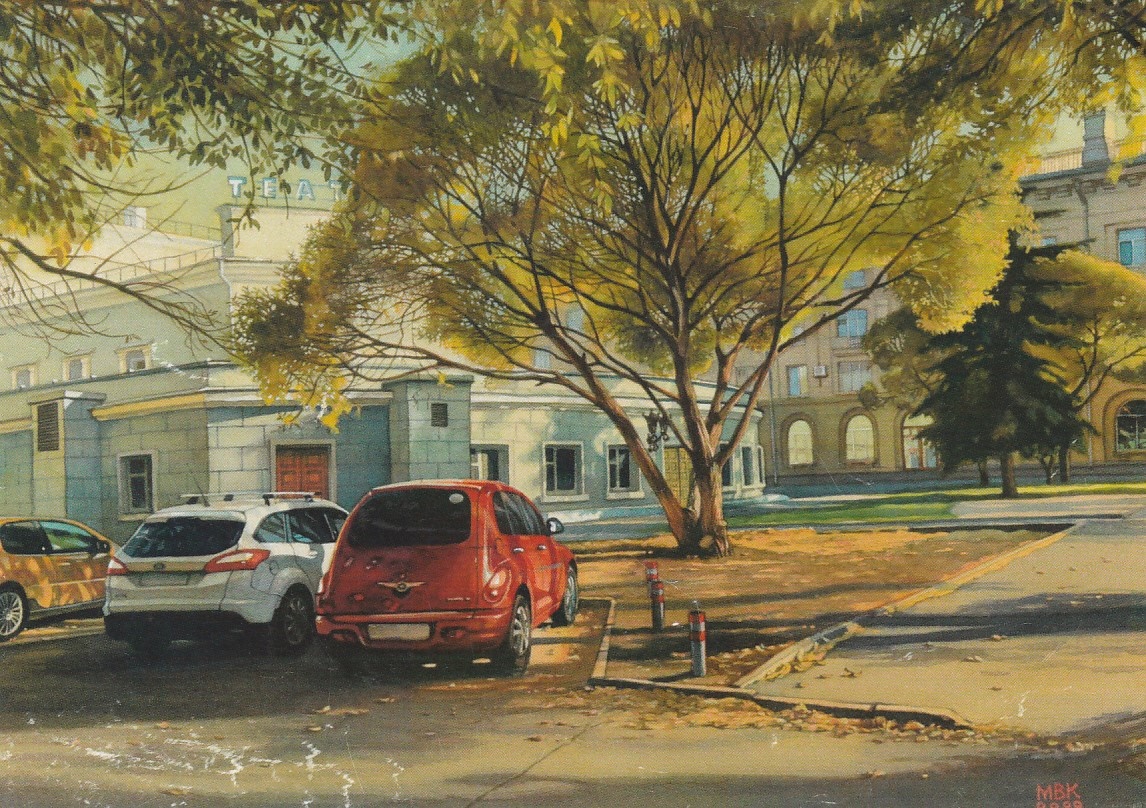
Cinema "Pushkin" in Chelyabinsk / Russia


These are not easy times to write about cinemas in Russia.

I recieved this postcard from Evgeniya from Chelyabinsk via Postcrossing. She sells postcards in her own web shop Edencards, including this one. The picture is painted by Mikhail Voronov-Kushakovsky, an artist from Chelyabinsk.

Cinema Pushkin in Chelyabinsk opened it doors in 1937, the centenary of the death of the great Russian poet A.S. Pushkin. Located almost in the very center, the cinema has become the most important component of the “Pushkin corner” of the city, along with Pushkin Street, the park and the library. 

The cinema wrotes: "For the natural life of a civilized man, memory is necessary: aesthetic and moral experience. For this, people come to our cinema. We want to present cinema 'different', author's. It goes differently to its audience. But most importantly, we hope that in our city the cinema named after Pushkin has already formed its audience."

What films are shown in these days there?
- La Croisade (Louis Garrel, France 2021)
- Otrovy i vybros (Kirill Sokolov, Russia 2021)
- Où est Anne Frank? (Ari Folman, Belgium, France, Luxembourg, Netherlands, Israel)
- Oslo, 31 August (Joachim Trier, 2011, Norway)
- Andrey Rublyov (Andrey Takovsky, 1969, USSR)


Спасибо, Евгения, за интересную открытку!

06.02.2022

Oktyabr in Moscow / Russia


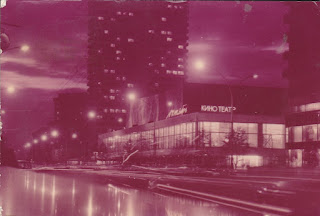
The cinema Oktyabr (October) on Novy Arbat opened in 1967 to commemorate the 50th Anniversary of the October Revolution. 

It was a purpose-built twin screen cinema, with 2.450 seats in the big hall and 442 seats in the small basement cinema. The main auditorium was equipped with Stereo 70 projection. Michail PosokhinAshot Mndoyants, Yuri Popov, A. Zhbakov, V. Turchinovich, G. Umnov were the architects. 

Cinema's facade is decorated with a mosaic panel made of natural stone, dedicated to the theme of the October Revolution (artists N. Andronov, A. Vasnetsov, V. Elkonin and L. Syrkin). This panel has the status of an object of cultural heritage of regional significance

In the interior of the cinema there is a stained-glass window made by the Lithuanian artist Algimantas Stoshkus based on his other work Song of Life

In 2005 the cinema was converted into a 11-screen multiplex with 1.518 seats in the biggest hall.

Today it is operated by the Karo chain of cinemas and is one of the host cinemas of the Moscow Film Festival. 

The postcard was published by APN - the Soviet Press agency and was sent in 1969. I don't know why it has this color.

15.01.2022

Rossiya in Moscow / Russia


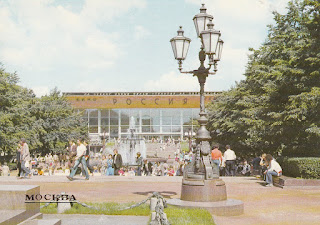
Now it's time for most famous Russian cinema - cinema Rossiya in Moscow.

Opened in 1961, it was the largest cinema hall in Europe and the main cinema hall of the USSR with an audiorium for 2.500 people. In the basement, there were two smaller halls with each 200 seats.

Yury Nikolayevitch Sheverdyaev, Dmitry Sergeyevitch Solopov and Elmira Gadshinskaya were the architects. The cinema was built in 1957-1961 on Pushkin Square on the site of the 1937 demolished Strastnoy Monastery

An architectural feature is the outstanding floating roof. This idea was already realised in the late 1920s in Moscow with the Rusakov's Worker Club by the architect Konstantin Melnikov

Another original solution that transformed the square was a staircase thrown across the street, connecting the foyer with the pedestrian boulevard of Pushkinskaya Square - one of the busiest city squares in the world.

The cinema has always hosted major events, such as the Moscow International Film Festival.

In 1997, the cinema Rossiya was leased to the large film distributor Karo Film, which renovated the theatre and changed its name to Pushkinsky. In 2012, the building was renovated to host musical performances and renamed Rossiya.

Of course, this building is protected as an architectural monument of regional significance.


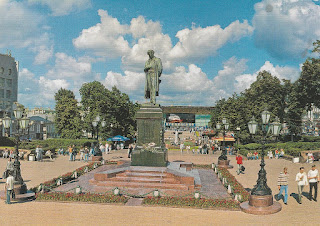
I recieved this postcard via postcrossing. In the foreground you can see the Pushkin monument (1880, by Alexander Mikhailovich Opekushin), in the background the Rossiya cinema. On the cinema, you can read the names Rossiya and Pushkinskiy. The cinema advertises the movie Война миров / War of the Worlds (USA 2005, directed by Steven Spielberg).

01.01.2022

Neptun in Novorossiysk / Russia

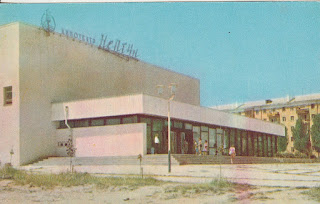
 Novorossiysk cinema Neptun postcard 1971

Novorossiysk cinema Neptun opened its doors to guests on May 1, 1969 - and the doors are still opened. Today it has two halls with 419 seats.

First shown film was the 1969 Soviet comedy Бриллиантовая рука / The Diamond Arm.

The building is located directly on the Black Sea. For a long time it was a special children's and youth cinema.

Another cinema in Novorossiysk I blogged: Ukraina.

14.05.2021

Moskva in Sankt-Peterburg / Russia


cinema Moskva Sankt-Peterburg Leningrad postcard 1960
In 1939, USSR's first three-hall cinema Moscow with 1200 seats was built. Its author is professor arch. Lazar Markovich Khidekel (1904-1986). The cinema was built on the site of the 1922 destroyed Church of St. Catherine in Yekateringof.
The facade of the cinema is faced with natural granite and marble, and the upper part is crowned with a sculptural frieze made by sculptor Igor .V. Krestovsky (1893-1976).
Cinema Moscow was  taken under state protection in 1967. The building is still standing, but there is no cinema.

The postcard is a little special. First, it is described - Soviet postcards in my collection were almost never sent. Second, it is noticeable that the reverse side is not printed at all. Usually there is the address field and numbers for the publication and also the price. The price, on the other hand, is on the front this time: ц. 1 Р. = Price 1 Rubel.


I suspect that the postcard was made and sold by a private person. Soviet DIY.

18.04.2021

Kolizey in Yekaterinburg / Russia

cinema Kolizey Yekaterinburg postcard

The cinema Kolizey (Coliseum) is (or was?) the oldest cinema in Yekaterinburg. The house was built in 1845 as the City Theater, the architect was Karl Tursky (1801-1884). The first cinema screening in Yekaterinburg took place in this house on November 7, 1896. A board on the building remembers this.

In 1914, there was opened the cinema Kolizey. After the 1917 revolution, the cinema was renamed October. In 1968, when the Salut cinema burned down, the October cinema was specialized as a children's cinema.

The historical name was returned in 2002 after the last reconstruction with 2 halls (280 and 33 seats).

When the photo was taken, cinema advertised the movie Garfield 2 (USA, 2006).

The cinema has closed for reconstruction since January 2019.

Dom Kino in Yekaterinburg / Russia

Yekaterinburg Dom Kino postcard 2006

Cinema Dom Kino (House of Cinema) is not the big new house in the foreground.  It's the higher house on the left. You can see a billboard for the movie Девушка из воды / Lady in the Water (USA, 2006) there. (But I bought this postcard with the inscription on the backyard "Dom Kino" ...)

Dom Kino belongs to the Sverdlovsk Regional Organization of the Union of Cinematographers of the Russian Federation and was opened on April 2, 1983. The architect was V.V. Permyakov.
The sculpture Muse Cinema is located above the entrance, created by Andrey Antonov.

There are two halls in the cinema: the big one with 269 seats and the small one with 53 seats.
Today it is one of the most important cultural centers of Yekaterinburg, where major creative and social events, Russian and international film festivals were held. 

It would be glad about a better postcard with this interesting place ... But I am glad finding a Wikipedia-site only for cinemas in Yekaterinburg. Отлично.

Velikan in Sankt-Peterburg / Russia


Saint Petersburg Leningrad cinema Velikan postcard 1954
Cinema Velikan (in English: Giant) was built in the end of the 19th century and was used as The People's House of Emperor Nicholas II. Architect was Alexander N. Pomarentsev (1849-1918), he is famous for the GUM department store in Moscow

The People's House was a publicly accessible cultural and educational institution in pre-revolutionary Russia (and not only in Russia). They contained libraries, theaters and restaurants and served above all for adult education for both workers and the middle class.  There were 20 people's houses in Saint Petersburg before 1917. In this building there was also an opera hall.

After the revolution of 1917, the people's houses retained their functions under the control of the new government - they became Workers' clubs, Houses of culture and Palaces of culture.

From the first days of the 1917 revolution, the People's House began to be used for various meetings. In May 1917, the 1st All-Russian Congress of Peasant Deputies met here, at which on May 22 V.I.Lenin delivered a big speech on the agrarian question. In 1918, a meeting was held here in honor of Karl Liebknecht's release from prison. In 1919 the city was named Petrograd and the People's House was named after Karl Liebknecht and Rosa Luxemburg.

On August 15, 1924 - now the city was named Leningrad - in this building the largest cinema in the USSR Velikan was opened. It accommodated about 2800 spectators. From 1950 till 1970 it was used as a music hall, and from 1959 till 1978 as a cinema again. 

To demonstrate stereoscopic films, the concert hall of the cinema with 211 seats was converted into Theater Stereokino in 1955.

The postcard is from this time (published in 1954). You can read "Поют - singing" on the ads, but nothing connected with cinema on the picture. There is only written on the backyard: Ленинград кинотеатр "Великан" - Leningrad cinema "Velikan".

On January 1, 1978, the cinema was closed for renovations and alterations of the stage to accommodate a music hall. In May 1988 the Music Hall was opened in this building and and still welcomes its guests to this day.

10.04.2021

Leningrad in Sankt-Peterburg / Russia


Cinema Leningrad Sankt Peterburg postcard 1959
Wikipedia knows:

The house was built in 1910-1914 according to the project of the architect Nikolai N. Ignatiev as an exhibition pavilion of the Imperial Russian Society of Horticulture in the Tavrichesky Garden quarter. In 1955-1956 it was reconstructed into a cinema by the project of the architect I. I. Chashnik. The cinema was opened on November 5, 1958. It was one of the first large-scale projects in this segment. The hall was equipped with a panoramic screen 28 meters wide and 10 meters high, as well as stereo sound.

The cinema had three halls: a hall with a panoramic screen with 1128 seats, Green Hall with 200 seats as a feature film hall and Blue Hall with 200 seats for popular science movies.

The loudest premieres took place here. For a long time Leningrad set the tone for the city's cultural life. By the end of the 20th century, the technical side of the cinema hall became obsolete, and the cinema life of the city moved to shopping and entertainment centers. In 2004 the cinema was closed.

After the reconstruction of the building by Ricardo Bofill in 2014, the Leningrad Center Show Space was opened in the building of the former Leningrad cinema. The art director of the show space is Felix Mikhailov, a well-known Russian theater, film and television director, screenwriter and producer. The repertoire of the show space includes large-scale performances at the intersection of various types of art: theater, musical, circus, ballet, kinetic art, puppet theater, video installations and 3D-mapping. In January 2018, regular film screenings were revived.

The postcard was published in 1959.

Here you can know more about cinemas in Sankt Peterburg.

05.04.2021

Rodina in Birobidzhan / Russia


Birobidzhan cinema Rodina postcard 1971
Birobidzhan is a town and the administrative center of the Jewish Autonomous Oblast, Russia, located on the Trans-Siberian Railway, near the China-Russia border. It has 75,413 inhabitants and its official language is Yiddish.

In the thirties, when the construction of the region was in full swing, residents were eagerly awaiting the appearance of a cinema house. The construction of the building was completed in 1937.

Its first name was "Genrikh Kazakevich ”- given in honor of the famous cultural figure Genrikh Kazakevich (1883–1935). Then the name changed Birobidzhan, and now Rodina

In 2002, the building of the cinema - one of the oldest in the city - was completely reconstructed. The cinema has two halls: “Black” with 98 seats and “Red” with 170 seats. In the cinema Rodina, there are showing films in Yiddish, Russian and English.

The postcard is from 1971. Unfortunately, it isn't possible to read the films advertised.

04.04.2021

Oktyabr in Taganrog/Russia


cinema Oktyabr in Taganrok postcard 1969
On skif_tags journal I found a wonderful article with great photos about cinema Oktyabr / October in Taganrog. Here is a part translated into English: 

"The cinema Oktyabr appeared in our city in 1937, to the 20th anniversary of the Great October Revolution, the main holiday of the country of the Soviets.
This was a typical project of the work of the talented architect Viktor Petrovich Kalmykov (1908-1981), who in the early 30s became famous for his futuristic project Saturniy (an international space city built on artificial rings encircling the earth)

But, the architect's real success can be considered his projects of typical cinemas, made in the style of constructivism. Suffice it to say that out of 60 cinemas built from 1935 to 1940 in various cities of the RSFSR, 50 were realized according to the projects of V.P. Kalmykov. For the anniversary of the revolution, cinemas similar to our Oktyabr appeared in many cities of the Soviet Union (Kirov, Frunse, Omsk).

Under German occupation in World War II between 1941 and 1943, the cinema continued to work and considered to soldiers. A musical group under the direction of Makarov performed in front of the audience in the foyer, and on weekends, local residents, everyone who wished, were allowed to see the sessions.

The cinema had two halls, a large one and a small one. A newsreel was shown in the small hall, and when the large hall was vacated, people from the small hall passed into the large one, which was through the wall. And the entire wall was pasted over with movie posters of past years from floor to ceiling. And it was the foremost entertainment to play the game find such and such a movie.
The main feature of the large hall was the gradually fading light. This was not the case in any other cinema in the city."

In 2007 the cinema was closed and the building is used for an alcohol market now ...

Here I found more pictures and information about cinemas in Taganrog. I am really surprised to found in this city of 258 000 inhabitants not only one big enthusiast of history and cinemas.

The postcard was published in 1969. Unfortunately, it isn't possible to read the films advertised.


10.03.2020

Rodina in Ufa/Russia

The Cinema Rodina (Motherland) is an historic cinema building in Lenin Street, the main street of Ufa. The building was opened in 1953, and is still working.
The cinema was built according to the project of architect Semyon Ivanovich Yakshin in the style of Stalin's Empire. The cinema had two large cinema halls - named Red and Blue, each with 350 seats. A small Green Hall with 60 seats was used for showing cartoons and documentaries. 
On the opening day in July 1953, thousands of Ufa residents visited the new cinema and watched the film Незабываемый 1919-й год / The Unforgettable Year 1919 (USSR, 1951).
In the 1990s, the cinema building underwent reconstruction, the cinema equipment was replaced.
It is now a listed building.
The cinema often holds film premieres with the participation of Russian filmmakers and also weeks of thematic cinema (Russian Film Festival, Indian Cinema Week, Kazakh Cinema Days).
The cinema building looks very similar to Cinema Ukraina in Novorossiysk, even I named there another architect.
The postcard is from 1990.

07.03.2020

Rossiya in Kislovodsk/Russia

Kislovodsk is a spa city in the North Caucasus region of Russia located between the Black and Caspian Seas. It has about 120.000 inhabitants.
Cinema Rossiya was opened in 1970 with 1000 seats. It closed in 2008, the postcard is from 1974.
There are plans for a culture center in it.

04.09.2019

Ukraina in Novorossiysk/Russia

Novorossiysk is an important Russian port on the Black Sea with about 240.000 inhabitants.
Cinema Ukraina was opened in 1955, K.M. Michailov was the architect. The postcard is from 1984.
In 1997, the building was opened as the City Palace of Culture. It provides leisure for the population, conditions for the development of folk art and amateur art to all citizens.
The building is located on Lenin square, you can see the statue of Lenin in frint of the cinema.

Another cinema in Novorossiysk I blogged: Neptun

01.09.2019

Awrora in Krasnodar/Russia

Krasnodar is the 16th most populated city in Russia with more than 1.000.000 inhabitants. 
Cinema Awrora opened there on 13 May 1967. The cinema was a project by Sochi Design Institute Giprokommunstroy under the direction of chief architect Yevgeny Serdyukov. 
The cinema has two halls, a big one with 1.179 seats and a small one with 130 seats.
Now it is closed for reconstruction. As written on website an open air cinema shows movies meantime. 
The sculpture of Aurora impresses the view of the cinema. It was created in 1967 on the 50th anniversary of the October Revolution by Ivan Shmagun. Aurora is the goddess of dawn in Roman mythology. But it has also a political statement. On 25 October (7 November new style) 1917, the cruiser Aurora in Petrograd (now Saint Petersburg) fired the first shot, signalling the beginning of the attack on the Winter Palace. 
The opening movie in this cinema was Залп «Авроры» / The Salvos of the Aurora Cruiser by Yuri Vyshinsky from 1965 about October Revolution, shown in 70mm format.

Yunost in Sankt-Peterburg /Russia

The cinema Юность / Yunost (Youth) - a typical Soviet cinema - was built in the years 1957-1960 according to the drawings of the architects Victor Matveevich Fromsel and Oleg Ivanovich Guryev. On the facade lined with pink tiles - sculptural images of a girl with a ribbon fluttering overhead and a young man with a lamp - disappeared in the 1990s.
Since 2003, the building has been owned by Balthouse LLC. They wanted to demolish the cinema and build a residential building in its place. Later it was decided to convert the house into a shopping and entertainment complex with a small cinema. 
Today there is a restaurant Yunost in this building, but no cinema.

29.04.2019

Barguzin in Irkutsk/Russia

In 1971, the Barguzin was opened.
Barguzin is the name of a river flowing into the Barguzin Bay of Lake Baikal and also the name of a strong wind on Baikal.
Today there is still a cinema Barguzin in Irkutsk. I am not sure if it is the old building renovated or a new built one.
This cinema is a typical widescreen cinema with 800 seats, found in some cities of former USSR, so for instance
  • Cinema Shipka in Kuibyshew, now Samara
  • Cinema Udogan in Chita
  • Cinema Iskra in Ufa
  • Cinema Krakow and Niwki in Kiev
  • Cinema Iskra in Perm
  • Cinema Komsomoletz in Mariupol
  • Cinema Kosmos in Kaluga
 Whether there is a postcard of every cinema?

28.04.2019

Oktyabr in Smolensk/Russia

Cinema Oktyabr - October - was opened on November 7, 1948 on the anniversary of the Great Socialist October Revolution. It had about 1.000 seats in two halls. Its construction began in 1938 according to a standard design developed by the architect Viktor Petrovich Kalmykov (1908-1981). He was the chief specialist in the design and construction of cinemas in the USSR. In total, there are four such cinemas left - Zvezda in Tver, Rodina in Elista, Simferopol in Crimea and Oktyabr in Smolensk.
Two years after the start, construction was suspended due to the termination of funding. During the German occupation in the unfinished building on July 16, 1943, the Vozrozhdenie cinema opened.The construction of the cinema was resumed in the autumn of 1945. The opening ceremony was held on November 7, 1948, and until 1970 it was the largest cinema in the city. 

In the early 2000s. the building fell into disrepair. Cinema closed about 2010. Periodically, the halls used for exhibitions - dinosaurs, butterflies, monkeys, wax figures and as a shopping mall.
The postcard is from 1962.
Here you can read more about the history of cinemas in Smolensk (in Russian).

27.04.2019

Pobeda in Kirov/Russia

Cinema Pobeda - Victory - in the Russian town Kirov was opened in 1955. It was built by Nikita Ivanovich Koslov in the so called Stalinist Empire style.
Today, this place is used for the Musical restaurant Gaudi.
The postcard was published in 1973.
Cinema Burevstnik in Nishni Novgorod nearly looks like Pobeda in Kirov. It was also opened in 1955 and still works.

04.03.2019

Metropol in Moscow/Russia

It is not easy to know something about this cinema. It is not listed on Russian Wikipedia side Cinemas in Moscow.
It was right in the building of the Hotel Metropol, a famous hotel in Moscow, built in 1899-1907 in Art Nouveau style.
In 1908, a novelty of the entertainment industry of that time appeared - the Opera-Kinemo, later named Modern. It was the first two-hall cinema in Moscow, changed its name in Soviet times into Metropol. Now it is closed.
Here you can see some interesting pictures from the cinema. 
It is easier to find this postcard then some information about Cinema Metropol on the internet. I bought this postcard on eBay.