Posts mit dem Label Philately werden angezeigt. Alle Posts anzeigen

12.12.2023

Odeon in Harrogate / United Kingdom

Odeon Harrogate PHQ postcard

The Odeon in Harrogate opened on 28th September 1936. The one hall had a total of 1,647 seats -  1,049 in the stalls and 598 in the circle.

First shown movie was the British comedy film Where’s Sally

Oscar Deutsch (1893-1941) was the owner of this cinema and the founder of Odeon Cinemas in 1928. 
1937, there were 250 Odeons, including the flagship cinema in Leicester Square, London, making Odeon one of the three largest cinema chains in the United Kingdom.

Like the majority of Odeon's cinemas, the Odeon Harrogate was built in the Streamlined Moderne style and was designed by Harry Weedon and W Calder Robson. Harry Weedon (1887-1970) became involved with the Odeon chain in 1934 and his company produced designs for some of the finest buildings of the period. Influenced by the work of Erich Mendelsohn and Hans Poelzig – the Odeons "taught Britain to love modern architecture".

The auditorium of Odeon Harrogate was divided in August 1972 with screen 1 forming the former circle and the front stalls with seating for 532 and screen 2 and 3 formed under the circle with 108 seats each. In 1989, the circle and front stalls were separated into 2 screens making 4 in total. Odeon Harrogate has since been modernised and has 5 screens today.

The building was awarded Grade-II listed status on 24 May 1988.

The postcard is a PHQ card (PHQ 178). PHQ (Postal Headquarters) cards are postcards issued by the British Post Office and represent the motifs of their commemorative stamps. 

This Postcard (and stamp) were issued in 1996 in a series of 5 stamps on the topic 100 Years of Cinema.

07.05.2021

125th anniversary of the cinema / Swiss Post


This first day letter is a gift from my sister. In December 2020, the cinema celebrated its 125th anniversary. Thanks to the Swiss Post, I was reminded of this. The birthday party was bigger 25 years ago ...

I love these stamps illustrated by Michael Stünzi. Cinema culture changed in the 125 years of its existence. On the left stamp a scene with the projector used by the Lumières is shown, in the middle can be seen classic rolls of film, and on the right there is a digitally presented 3D experience. The cinema audience wears the fashion of the respective era.

I like the creative idea that everyone is sitting in the same two rows, connected through the times (look at the different chairs!) - and printed as stamps together. Maybe the girl left is the older woman in the middle. And the man with the mustache in the middle could be the old man on the right (without the 3D-glasses). The projectionists were not forgotten either. Even if I would have liked it better if the woman in the middle had worn dungarees...

You can see on the envelope a cinema-building in the three ages with people also showing on the stamps. At all, you can tell little stories with these little pictures.

Times are changing and the cinema as a place looking films together will continue. Hopefully! Let's be creative!

23.09.2020

Röda Kvarn in Halmstad/Sweden


Cinema Roda Kvarn Halmstad postcard 1998
Another maximum card showing a cinema building, published in Sweden in 1998. The design was by Eva Lena Johansson, the stamp was made by Piotr Naszarkowski, photo was taken by Kjell Furberg.
Furberg, who worked as a cinema machinist, has made a name for himself as a cinema historian and his book Svenska Biografer / Cinema Theatres in Sweden was published in 2000. 
The cinema Röda Kvarn ("Red Mill") was built in 1925 according to drawings by the town architect August Svensson (1886–1935). Opening in February 1926, it had 500 seats in one hall.
What distinguishes the cinema is mainly a magnificent classicist screen façade on two floors that is unparalleled in Sweden. Changes have been made to the interior during the 1950s and 1970s, mainly in terms of surface layers, proscenium and ticket office, but on the whole the interior is well preserved with a lounge, balcony and lower and upper foyer. Many time- and cinema-typical details are preserved. The cinema conveys knowledge about the aesthetic ideals of the 1920s and about the importance that the cinema had as a central entertainment palace during the early 20th century. Its unique façade reflects the ambition to give the cinema and the film a reputation and status as a cultural institution through a pompous architecture.
The cinema has been a building monument since 27 May 1994.
Today cinema Röda Kvarn has five halls with 562 seats at all. It is Halmstad's only cinema.

23.08.2020

Cathay in Singapore


Cathay Cinema in the Cathay Building was opened on 3 October 1939. The building was the first skyscraper in Singapore and at a height of 83.5 metres the tallest building in Southeast Asia at that time. It was designed by British architect Frank W. Brewer and was the headquarters for the British Malaya Broadcasting Corporation.
Cathay Cinema had 1.300 seats and it was the island's first air-conditioned cinema.
The name Cathay is an alternative European historical name for China and from the 1935 founded Cathay Organisation Holdings Limited, a Singapore's leisure and entertainment group.
In 1990, Cathay Organisation opened Singapore's first arthouse cinema, The picturehouse adjacent to Cathay Building. The main Cathay Cinema was then converted into a two-hall cineplex.
Cathay Cinema closed in 2000. The front facade of its theatre building structure was gazetted as a national monument for conservation on 10 February 2003, while the rest of the building structure was later demolished.
The newly built Cathay was opened on 24 March 2006. Today there is the 8-screen Cathay Cineplex.
You can see on the postcard, the poster for the movie They Shall Have Music (USA, 1939) and above the entrance advertising for The Man in the Iron Mask (USA, 1939).

Queen's Theatre in Singapore


It's not easy to read the cinema's name in the middle of all these posters.
Queen's Theatre is a cinema in the Singaporean suburb Geylang. It opened in 1930 as Wembley Cinema.
In 1939 the name was changed into Queen's Theatre.
The photo is from autumn 1940 and the advertised movies are:
- Espionage Agent (USA, 1939)
- Siti Akbari (Dutch East Indies, 1940)
- Her Jungle Love (USA, 1940)
- Block-Heads with Laurel & Hardy (USA, 1938).
The writing at the top does not announce a new film: They are greetings for the Muslim Festival of breaking the Fast. Greetings connected with the names of poplar actors Rokiah, Radin Mochtar, Kartolo, Annie Landouw and Titing - all from Indonesia.
Also the poster at the bottom left doesn't advertise a film either: Kronchong is the name of a ukulele-like instrument and an Indonesian musical style. Also popular at the movies.

So you had could spend a good time at the Queen's Theatre.
The cinema was closed in 1982.
In 2000, GrandLink Square was built on the site of the former Queen’s Theatre. Its front facade was kept and become part of the facades of the GrandLink Square.

The Majestic in Singapore


The Majestic Theatre opened in 1928. It was built as an opera house by buisnessman Eu Tong Sen for one of his wives, who loved Cantonese Opera. Eu also formed an opera troupe for her.
The building was designed by Swan and Maclaren, most prominent architectural firm in Singapore at this time. The centre of the facade is decorated with five Chinese figures, and is framed with a tiled Chinese style border.
The Majestic Theatre was a venue for Cantonese opera until 1938, then it was converted into a cinema. The Shaw Brothers rented the place, renamed it The Queen's Theatre, and used it to screen the latest Cantonese blockbuster films. On the postcard, you can see all the posters advertise movies with Chinese letters.
In 1998 the cinema was closed.
In the early 2000s, the building was renovated into a three-story shopping mall and opened under the name The Majestic on 17 January 2003.

Capitol Building in Singapore


It's a bit strange about Capitol in Singapore: There is Capitol Theatre and Capitol Building (so written on the stamp). Both buildings were built in 1929/30 and stand next to each other. But there is only one cinema opened on 22 May 1930 - the Capitol Theatre.
The Capitol Theatre was designed neoclassical architecture by British architects Keys and Dowdeswell, inspired from the Roxy Theatre in New York. It had 1.100 seats on the ground floor and 500 seats at the circle. On 22 May 1930, Capitol Theatre officially opened with musical comedy film Rio Rita (USA, 1929).
In the 1930s, the Capitol was the largest and the newest cinema in Singapore.
Movie stars like Charlie Chaplin, Ava Gardner, Mary Pickford and Douglas Fairbanks visited the theatre to promote their movies in Singapore.
In 1989, the theatre closed for a two-week renovation with rewiring, reequipped with the new sound system and projectors and painting of the cinema hall and reopened on 26 October 1989 with Lethal Weapon 2. But closed in December 1998. 
Fortunatelly, the Capitol reopened on 19 May 2015 with the world premiere of Singapura: The Musical. Now 977 seats are ready for different venues.
The advertised movie is Bengal Brigade (USA, 1954).

21.08.2020

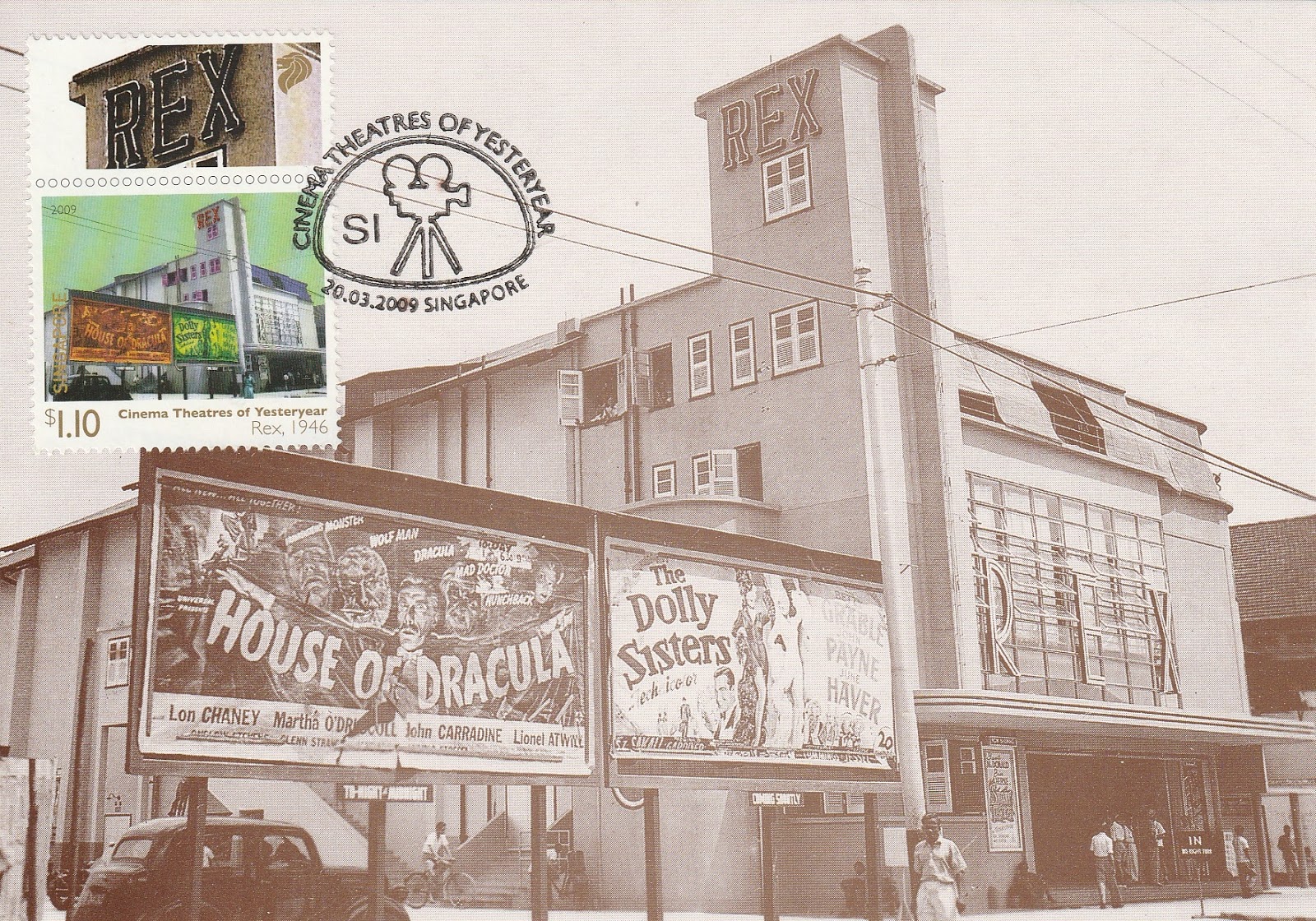
Rex Theatre in Singapore

SingPost - the Singapore Post - was releasing in 2009 a set of Cinema Theatres of Yesteryear stamps featuring the cinemas Cathay, The Majestic, Capitol, Queens and Rex. I had the chance to buy this issue as maximum cards.
The first public screening in Singapore was in 1902 at a tent in an open space at the junction of River Valley Road and Hill Street, and that the first movie theatre opened its door in 1904.
Rex Theatre was opened in 1946.
It was designed by Berthel Michael Iversen, a Danish architect
. Rex Theatre had to shut down its doors in 1976 due to rampancy of videotape piracy. From then on there were no cinemas in the district. 
Later it was a performance house, an ice rink, a Methodist Church and a disco. In 2009, Rex Theatre was converted into a 3 hall modernised cinema and reopened as Rex Cinemas. The main hall on the ground floor has 570 seats, while the other two can accommodate 82 patrons each. In 2018 the cinema was closed again.
On the photo (it is the same on the stamp and on the postcard) you can see promoting the movies House of Dracula (USA, 1945) and The Dolly Sisters (USA, 1945).
Here you can find memories and pictures of Rex Theatre.

19.07.2020

Bergen Kino / Norway

The first public film screening in Norway was on April 6, 1896. Christiania's Circus Variete had something completely new in the program: Max Skladanowsky showed "levende bilder" with his bioscop. 
But I don't know what the date "September 20, 1896" (like written on this postcard) means for Norwegian cinema history. It was the first issue date of the stamp series.
You can see on the stamp:
- Norwegian actor Leif Juster
- Scottish producer and actor Sean Connery and Norwegian actress Liv Ullman
- Norwegian actors Arve Opsahl, Sverre Holm and Carsten Byhring from the Norwegian Olsenbanden
- Norwegian actor, comedian and singer Harald Heide-Steen jr.

On the postcard, you can see the cinema Konsertpaleet. It opened in 1961 and has over time been expanded and merged into a modern multi-storey cinema. Next to it, multiplex cinema Magnus Barfot opened in 2004.