23.08.2020

Cathay in Singapore


Cathay Cinema in the Cathay Building was opened on 3 October 1939. The building was the first skyscraper in Singapore and at a height of 83.5 metres the tallest building in Southeast Asia at that time. It was designed by British architect Frank W. Brewer and was the headquarters for the British Malaya Broadcasting Corporation.
Cathay Cinema had 1.300 seats and it was the island's first air-conditioned cinema.
The name Cathay is an alternative European historical name for China and from the 1935 founded Cathay Organisation Holdings Limited, a Singapore's leisure and entertainment group.
In 1990, Cathay Organisation opened Singapore's first arthouse cinema, The picturehouse adjacent to Cathay Building. The main Cathay Cinema was then converted into a two-hall cineplex.
Cathay Cinema closed in 2000. The front facade of its theatre building structure was gazetted as a national monument for conservation on 10 February 2003, while the rest of the building structure was later demolished.
The newly built Cathay was opened on 24 March 2006. Today there is the 8-screen Cathay Cineplex.
You can see on the postcard, the poster for the movie They Shall Have Music (USA, 1939) and above the entrance advertising for The Man in the Iron Mask (USA, 1939).

Queen's Theatre in Singapore


It's not easy to read the cinema's name in the middle of all these posters.
Queen's Theatre is a cinema in the Singaporean suburb Geylang. It opened in 1930 as Wembley Cinema.
In 1939 the name was changed into Queen's Theatre.
The photo is from autumn 1940 and the advertised movies are:
- Espionage Agent (USA, 1939)
- Siti Akbari (Dutch East Indies, 1940)
- Her Jungle Love (USA, 1940)
- Block-Heads with Laurel & Hardy (USA, 1938).
The writing at the top does not announce a new film: They are greetings for the Muslim Festival of breaking the Fast. Greetings connected with the names of poplar actors Rokiah, Radin Mochtar, Kartolo, Annie Landouw and Titing - all from Indonesia.
Also the poster at the bottom left doesn't advertise a film either: Kronchong is the name of a ukulele-like instrument and an Indonesian musical style. Also popular at the movies.

So you had could spend a good time at the Queen's Theatre.
The cinema was closed in 1982.
In 2000, GrandLink Square was built on the site of the former Queen’s Theatre. Its front facade was kept and become part of the facades of the GrandLink Square.

The Majestic in Singapore


The Majestic Theatre opened in 1928. It was built as an opera house by buisnessman Eu Tong Sen for one of his wives, who loved Cantonese Opera. Eu also formed an opera troupe for her.
The building was designed by Swan and Maclaren, most prominent architectural firm in Singapore at this time. The centre of the facade is decorated with five Chinese figures, and is framed with a tiled Chinese style border.
The Majestic Theatre was a venue for Cantonese opera until 1938, then it was converted into a cinema. The Shaw Brothers rented the place, renamed it The Queen's Theatre, and used it to screen the latest Cantonese blockbuster films. On the postcard, you can see all the posters advertise movies with Chinese letters.
In 1998 the cinema was closed.
In the early 2000s, the building was renovated into a three-story shopping mall and opened under the name The Majestic on 17 January 2003.

Capitol Building in Singapore


It's a bit strange about Capitol in Singapore: There is Capitol Theatre and Capitol Building (so written on the stamp). Both buildings were built in 1929/30 and stand next to each other. But there is only one cinema opened on 22 May 1930 - the Capitol Theatre.
The Capitol Theatre was designed neoclassical architecture by British architects Keys and Dowdeswell, inspired from the Roxy Theatre in New York. It had 1.100 seats on the ground floor and 500 seats at the circle. On 22 May 1930, Capitol Theatre officially opened with musical comedy film Rio Rita (USA, 1929).
In the 1930s, the Capitol was the largest and the newest cinema in Singapore.
Movie stars like Charlie Chaplin, Ava Gardner, Mary Pickford and Douglas Fairbanks visited the theatre to promote their movies in Singapore.
In 1989, the theatre closed for a two-week renovation with rewiring, reequipped with the new sound system and projectors and painting of the cinema hall and reopened on 26 October 1989 with Lethal Weapon 2. But closed in December 1998. 
Fortunatelly, the Capitol reopened on 19 May 2015 with the world premiere of Singapura: The Musical. Now 977 seats are ready for different venues.
The advertised movie is Bengal Brigade (USA, 1954).

21.08.2020

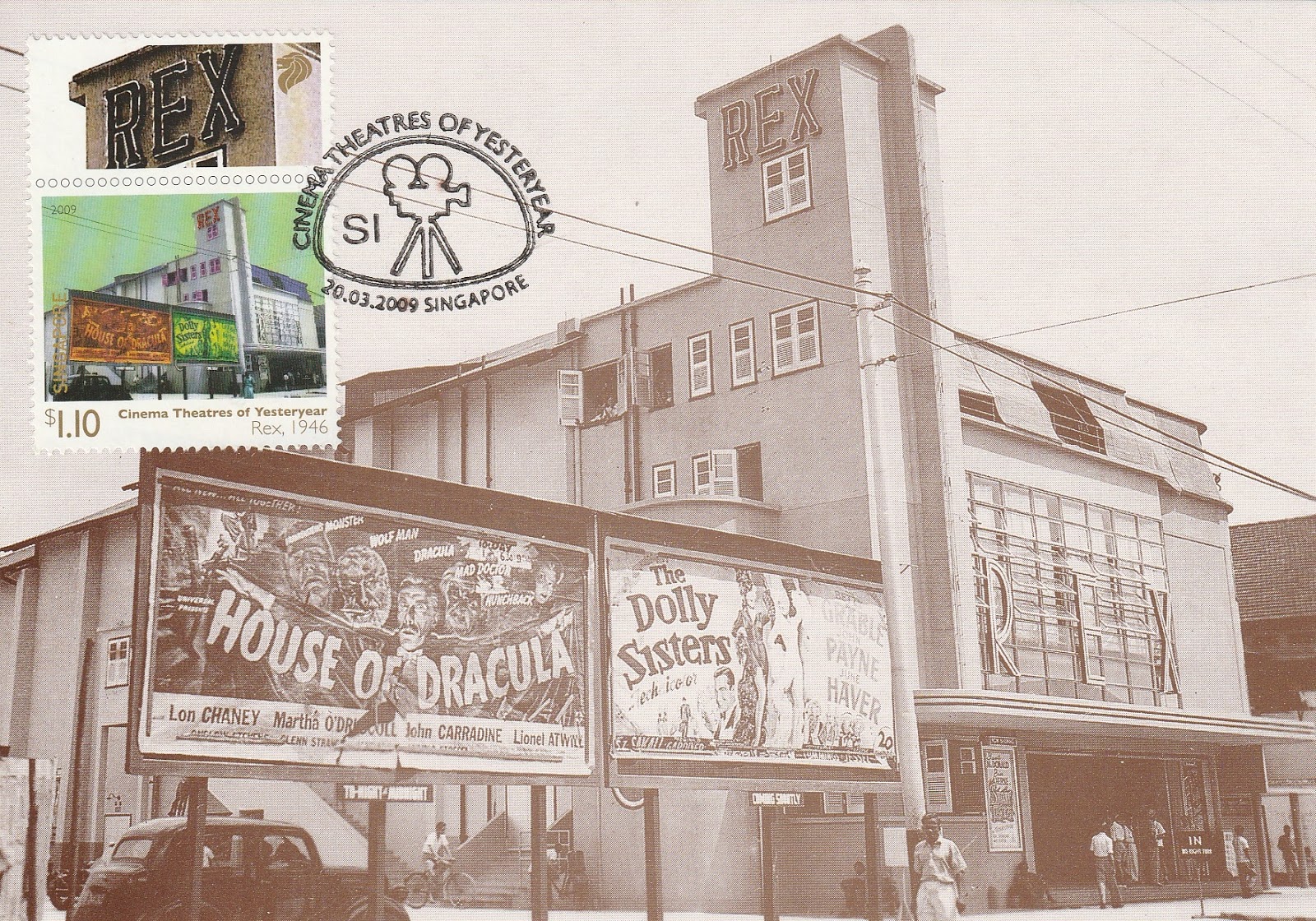
Rex Theatre in Singapore

SingPost - the Singapore Post - was releasing in 2009 a set of Cinema Theatres of Yesteryear stamps featuring the cinemas Cathay, The Majestic, Capitol, Queens and Rex. I had the chance to buy this issue as maximum cards.
The first public screening in Singapore was in 1902 at a tent in an open space at the junction of River Valley Road and Hill Street, and that the first movie theatre opened its door in 1904.
Rex Theatre was opened in 1946.
It was designed by Berthel Michael Iversen, a Danish architect
. Rex Theatre had to shut down its doors in 1976 due to rampancy of videotape piracy. From then on there were no cinemas in the district. 
Later it was a performance house, an ice rink, a Methodist Church and a disco. In 2009, Rex Theatre was converted into a 3 hall modernised cinema and reopened as Rex Cinemas. The main hall on the ground floor has 570 seats, while the other two can accommodate 82 patrons each. In 2018 the cinema was closed again.
On the photo (it is the same on the stamp and on the postcard) you can see promoting the movies House of Dracula (USA, 1945) and The Dolly Sisters (USA, 1945).
Here you can find memories and pictures of Rex Theatre.

14.08.2020

Cinedom in Köln/Germany

Cinedom in Köln/Cologne is one of the oldest multiplex cinemas in Germany. It was opened on December 20, 1990. The oldest multiplex cinema in Germany is only 10 kilometers away: UCI Kino Hürth Park, opened in October 1990, today with 14 halls. But despite its size and marketing, you'll rarely find a postcard with a multiplex cinema.
I got this postcard from Carla from Cologne via Postcrossing. It isn't a published postcard, it was made by herself and internet. An unique postcard.
The movie theater was a project of film producer Bernd Eichinger (1949-2011). He wanted good cinemas for good films, not the box cinemas of the 70s and 80s. A cathedral for movies with large screens, high technology and convenience for everybody. The architect was Eberhard Zeidler.
The centerpiece of the complex with its tuff facade, is the fully glazed rotunda that opens onto the central square of the Media Park and is covered by a dome at a height of over 30 meters. The 30-meter-high building has a large glass facade on its front side facing the square, which allows a view of the interior of the Cinedom at night.
Tody the Cinedom offers 3748 seats in 14 halls, making it the fifth largest German multiplex cinema. Since 1997, the Cinedom has been the cinema with the highest turnover and the highest number of visitors in Germany.
Danke, Carla, für diese Postkarte!

New Victoria Cinema in London/United Kingdom


I got this perfect card from Marleen from Belgium via Postcrossing: A view of the New Victoria Cinema in London. I think the photo is from the 1930s.
The building is across from London Victoria Station and today known as Apollo Victoria Theatre
The theatre opened as the New Victoria Cinema on 15 October 1930 with the movie Old English (United Kingdom, 1930), plus a stage show Hoop-La. It was designed for Provincial Cinematograph Theatres (PCT) by William Edward Trent and Ernest Wamsley Lewis.
The interior is unique and a testament to art deco design.
Seating capacity was originally for 2,860, with 1,076 in the balcony. The stage designed for cine-variety  measures 22.56 metres by 7.32 metres. 
Film entertainment ended here on 1st November 1975 with the double bill: Legend of the Werewolf  (United Kingdom, 1975) and Vampire Circus (United Kingdom, 1972).
The Apollo Victoria became in 1981 a venue for musical theatre, beginning with The Sound of MusicStarlight Express from 1984 to 2002, now the musical Wicked since 2006.
The Apollo Victoria is one of the UK’s best preserved 1930’s ‘super cinemas’ and its unique design and excellent condition fully justify its Grade II* Listed building status which was bestowed by English Heritage in 1972. A real cinema treasure.
Dank u, Marleen!

28.07.2020

Kino Sõprus in Tallinn/Estonia

Kino Sõprus is the oldest existing cinema in Estonia. The house was built in 1955. Its name is meaning "Friendship", an often used name of cinemas in former socialist countries.
The postcard is from Eesti Arhitektuurimuuseum / Museum of Estonian Architecture. They have written the names of the architects on the postcard: Peeter Tarvas and August Volberg. The photo was taken by Karl Oras.

There are advertised two movies:
- on the right Бессонная ночь / Unetu öö / Sleeples Night (USSR, 1960)
- on the left Зимняя фантазия / Talvi Fantaasia / Winter fantasy (USSR, 1960).
The cinema had from beginning two halls. Today they have  210 seats plus 30 seats in the cinema bar in one hall.
I got this postcard via Postcrossing. Tänud, Marianne!

19.07.2020

Sandleitenkino in Wien / Austria


The postcard was sent in 1935, has published before 1934. In 1934 the street's name was changed from Liebknechtgasse to Eberhartgasse.

The cinema opened in 1928 and had 600 places. In 1930 there came sound film, in 1966 the cinema was closed.
I bought this postcard because Sandleiten is an interesting residential area in Vienna. As part of the "Red Vienna" residential building policy, it is an urban residential complex with 1.587 apartments originally built in five stages from 1924 to 1928. The complex, the building blocks of which are mainly divided according to the angle of the sun, is located in the middle of a park-like complex with only a few streets. Its basic concept emerged from an architectural competition and was viewed as an urban planning attempt. 
The large residential complex was then built according to designs by Otto Schönthal, Emil Hoppe, Franz Matuschek, Siegfried Theiß, Hans Jaksch, Josef Tölk and Franz Krauß.
There were planned not only apartments for 5.000 to 6.000 inhabitants, also doctor's apartments, pharmacies, shops, workshops, an inn and a café, rooms for the police and fire service, laundries, bathing facilities, a kindergarten and a library. And a cinema. Everything you need for a good life.

Bergen Kino / Norway

The first public film screening in Norway was on April 6, 1896. Christiania's Circus Variete had something completely new in the program: Max Skladanowsky showed "levende bilder" with his bioscop. 
But I don't know what the date "September 20, 1896" (like written on this postcard) means for Norwegian cinema history. It was the first issue date of the stamp series.
You can see on the stamp:
- Norwegian actor Leif Juster
- Scottish producer and actor Sean Connery and Norwegian actress Liv Ullman
- Norwegian actors Arve Opsahl, Sverre Holm and Carsten Byhring from the Norwegian Olsenbanden
- Norwegian actor, comedian and singer Harald Heide-Steen jr.

On the postcard, you can see the cinema Konsertpaleet. It opened in 1961 and has over time been expanded and merged into a modern multi-storey cinema. Next to it, multiplex cinema Magnus Barfot opened in 2004.