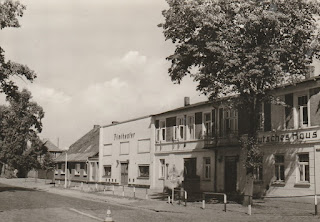
The Saalbau (Hall Building) in Neustadt an der Weinstrasse is was built in Neo-Renaissance style as a multifunctional event building between 1871-73. The cinema Saalbau-Lichtspiele was added to this building in 1930 in the Bauhaus style. The architect was Joseph Glückert.
25.03.2022
Saalbau-Lichtspiele in Neustadt an der Weinstraße / Germany
19.03.2022
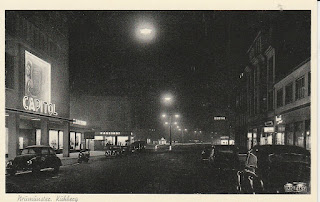
Capitol in Neumünster / Germany
In October 1950 the Capitol in Neumünster was opened. It had 827 places. Hermann Rein was the architect. He also redesigned the Capitol in Flensburg in 1951.
In the 1970s, the cinema was converted into a cinema center with three halls.
It was closed in 2000 after the opening of a new multiplex in the former Karstadt department store, just a few meters away.
In 2008, the building was demolished.
A few words about the advertised film on the postcard. It seems to be the film Csardas der Herzen (Germany, 1951). Only "Csardas" is readable.
14.03.2022
Roxy in Geleen / Netherlands
The cinema Roxy in Geleen was designed and built by the architect Pieter Augustinus Schols (1892-1873) in 1932. It had 900 seats in 1933. When it was closed on 31th December 2003, it had 468 seats.
I found on youtube a video made in the empty cinema:
Roxy Geleen 2019: The making of .... Fortuna '54, de pioniers van het betaald voetbal.
Not far awy there is a new cinema Foroxity - the largest cinema in the Limburg region with 8 halls and 1.936 places.
13.03.2022
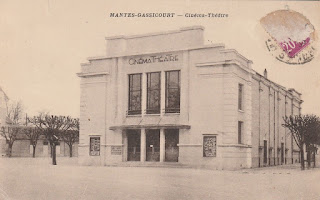
Cinéma-Théâtre in Mantes-Gassicourt / France
Mantes-Gassicourt, since 1953 Mantes-la-Jolie, is 48 km to the northwest of Paris.
The first Cinéma-Théâtre was opened on 4th November 1921, built on the site of a theater destroyed by fire. First shown film was Les Trois Mousquetaires (France, 1921).
That cinema was closed on 2nd February 1934 and the new Cinéma-Théâtre was built on this site. It was opened on 22nd August 1934 and had about 1.100 seats. It has been demolished too.
A new 9-screen CGR multiplex has been built on the site in 2000 and still shows movies.
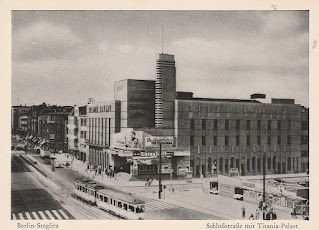
Titania-Palast in Berlin / Germany
The Titania-Palast opened on 28th January 1928 for vaudeville shows and movies. The opening film was Der Sprung ins Glück (France/Germany/Italy 1928) and a revue on the stage Wien und die Wienerin.
The cinema with 1.924 seats was built in the style of the New Objectivity by the architects Ernst Schöffler, Carlo Schloenbach and Carl Jacobi and based on American models, the cubic, almost bulky building on the 2700 m² property caused a sensation with its almost completely unadorned facade at the time of construction, which also from that time was positively received by the public and the press.
At night, the building transforms and reveals which aspect the architects want to focus on: the light architecture. The electric light, symbol of the pulsating city of Berlin, is used in different ways. 27 light strips made of opal glass turn the corner tower into a light tower at night, making the cinema visible from afar. The cinema name TITANIA PALAST is displayed in neon tubes, the announcements for the films above the entrance are also illuminated.
The cinema survived World War II without much damage. In June 1951, the first Berlin International Film Festival - Berlinale - took place at Titania Palast. In 1953, the house was equipped with CinemaScope.
The last film was shown in December 1965 and the last operetta was played a month later.
In 1966, the Titania Palast narrowly escaped demolition. The Berlin energy supplier Bewag prevented this by leasing part of the building. The great hall was leased to retail outlets. Other parts of the building were used as a rehearsal stage from 1972 to 1994.
In 1995, a multiplex-cinema with 5 screens opened, using only a small part of the original building.
Today's Titania only has the name and location in common with the historic cinema. Externally, however, many architectural features of the original building have been preserved. The house has today seven projection halls with a total of around 1100 seats and is a listed building
The postcard shows the cinema advertising the film Der Hauptmann von Peshawar / King of the Khyber Rifles (USA, 1953) with Tyrone Power. The film was one of the first shot in Technicolor CinemaScope. It came on 30th April 1954 to West German cinemas.
12.03.2022
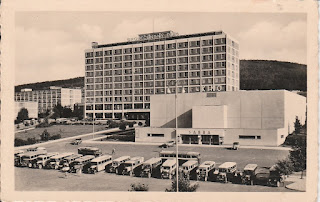
Velké Kino in Zlín / Czech Republic
Zlín was famous for its shoe industry - Bata shoes.
Tomáš Baťa and his siblings founded a shoe factory there in 1894. During the production gradually increased, as did the number of employees and the population of the town. Due to the remarkable economic growth of the company and the increasing prosperity of its workers, Baťa himself was elected mayor of Zlín in 1923.
Besides producing footwear, the company diversified into engineering, chemistry, rubber technology and many more areas. The factory hired thousands of workers who moved to Zlín. A new large complex of modern buildings and facilities was gradually built by the Baťa's company on the outskirts of the town in 1923–1938. It included thousands of flats, schools, department stores, scientific facilities, a hospital. The development took place in a controlled manner and was based on modern urban concepts with the contribution of important architects of the time. Zlín became a hypermodern industrial city with functionalist character unique in Europe.
Among these building, there was opened Velké Kino (Great Cinema) on September 6th, 1932. With its capacity of 2,270 seats it was the largest pre-war cinema in Czecholslovakia.
The functionalist building by architect František Lýdie Gahura (1891-1958) was built in 1932 by the Baťa company, Thanks to this, a unique welded steel structure was used in the construction, to such an extent for the first time in the territory of the then Czechoslovakia.
Bat'a encouraged his employees to go to the cinema: he often showed films there in their original versions in order to learn foreign languages. The cinema was hit by Allied air raids in 1944.
The cinema has hosted the International Film Festival for Children and Youth every year from 1961 till 2016. (The city wears the name Gottwaldov from 1949 to 1990).
The building has been protected as a cultural monument since 2001. It has to been closed since 2016 due to its bad statics.
Read here more about cinemas and their history in Zlín.
I found there an interesting fact about the shown picture: Above the cinema's entrance you can read the word SABRA. This wasn't the name of the cinema. The author of the website suspects a symbol of resistance of the cinema against the German occupiers in the choice of this word to designate the cinema.
In 1933 there was a Polish film called Sabra about young Polish Jews went to Palestine. But of corse this movie wasn't shown in Zlín during the German occupation. Sabra (or Tzabra) is a Hebrew word for any Jew born in Palestine / Israel.
The postcard was published during the German occupation 1939-1945. There is written on the backyard "5181. Freigegeben durch RLM (Reichsluftfahrtministerium)" - Released by the Reich Air Ministry. But the description is in Czech "ZLÍN - Společenský dům a kino Bata" (not kino Sabra!).
22.02.2022
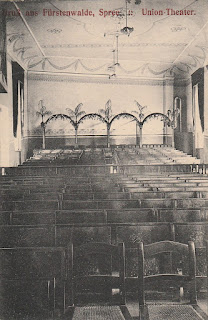
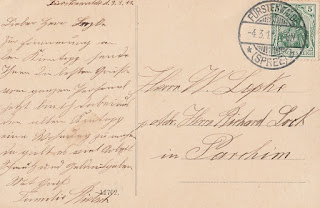
Union-Theater in Fürstenwalde / Germany
The postcard was sent in 1911 - 111 years ago. Another surprise - the cinema is mentioned on the back.
20.02.2022
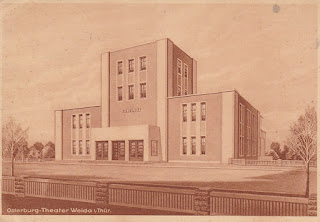
Osterburg-Theater in Weida / Germany
The castle Osterburg is located in the Thuringian Vogtland. It lies prominently above the river Weida and the town of the same name. And is worth visiting.
06.02.2022
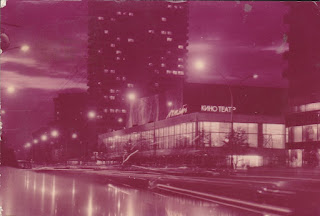
Oktyabr in Moscow / Russia
The cinema Oktyabr (October) on Novy Arbat opened in 1967 to commemorate the 50th Anniversary of the October Revolution.
It was a purpose-built twin screen cinema, with 2.450 seats in the big hall and 442 seats in the small basement cinema. The main auditorium was equipped with Stereo 70 projection. Michail Posokhin, Ashot Mndoyants, Yuri Popov, A. Zhbakov, V. Turchinovich, G. Umnov were the architects.
Cinema's facade is decorated with a mosaic panel made of natural stone, dedicated to the theme of the October Revolution (artists N. Andronov, A. Vasnetsov, V. Elkonin and L. Syrkin). This panel has the status of an object of cultural heritage of regional significance
In the interior of the cinema there is a stained-glass window made by the Lithuanian artist Algimantas Stoshkus based on his other work Song of Life.
In 2005 the cinema was converted into a 11-screen multiplex with 1.518 seats in the biggest hall.
Today it is operated by the Karo chain of cinemas and is one of the host cinemas of the Moscow Film Festival.
The postcard was published by APN - the Soviet Press agency and was sent in 1969. I don't know why it has this color.
Filmtheater in Lübtheen / Germany
Lübtheen is a village near Hamburg. Today it has about 4.600 inhabitants and no cinema.
The postcard was published in 1979.
I couldn't find much information about the cinema on the postcard. allekinos.com writes, the cinema was opened on June 15th, 1919 and closed about 1990. There weren't shown movies every day. It seems the hall belonged to the restaurant Deutsches Haus at the right.